 PixQR
Overview
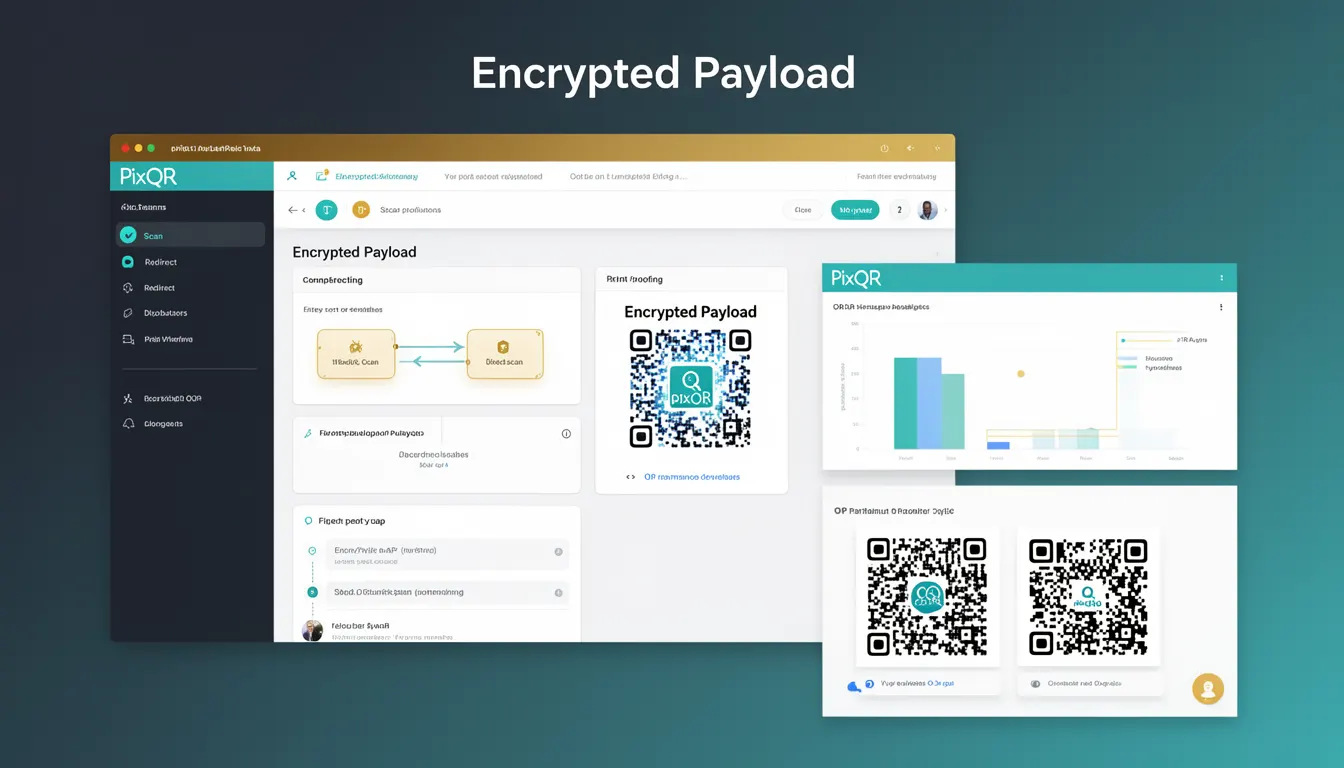
An Encrypted Payload refers to the technique of encrypting the data content within a QR code to ensure that the information it contains remains secure and tamper-proof during transmission and interpretation. This method is particularly relevant in environments where QR codes are used to convey sensitive information, such as URLs, user credentials, or private data, and where the integrity of that data must be maintained.
In the context of PixQR, an Encrypted Payload is implemented to support secure QR code generation and redirection workflows. It allows developers to protect the content of a QR code from being read, altered, or exploited by unauthorized parties. This is especially critical in scenarios involving dynamic redirects, brand-safe designs, and privacy-compliant link management.
Why It Matters
For developers and platform operators, encrypted payloads in QR codes are essential for mitigating risks such as data leakage, phishing, and unauthorized access. In environments where QR codes are used for authentication, access control, or sensitive data transfer, failure to encrypt payload data can lead to exploitation and security breaches.
PixQR supports encrypted payloads to ensure that even if a QR code is scanned and its content intercepted, the underlying data remains unreadable without the appropriate decryption key. This is especially important in business-to-business or enterprise applications where data privacy and compliance are paramount. Furthermore, it enhances the trustworthiness of the platform by ensuring that only authorized systems can interpret the QR code content.
How It Works
When a QR code is generated with an encrypted payload, the data within the QR code is encrypted using a defined encryption algorithm before being encoded into the QR symbol. The recipient of the QR code must then possess the appropriate decryption key or method to retrieve the original data.
- The payload encryption process is typically performed server-side during QR code generation, ensuring that sensitive data is never exposed in plaintext.
- Encryption algorithms such as AES-256 are commonly used to secure the data, providing a high level of security against unauthorized access.
- The encrypted payload is then encoded into the QR code using standard QR code encoding techniques, maintaining compatibility with standard QR readers.
- When a QR code is scanned, the system must decrypt the payload using the correct key or method before redirecting or processing the data.
- PixQR supports integration with secure key management systems to ensure that encryption keys are stored and rotated securely, minimizing the risk of key compromise.
Quick Reference
| Item | Purpose | Notes |
|---|---|---|
| Encryption Algorithm | Secures the QR payload data | AES-256 recommended for production |
| Key Management | Stores and rotates encryption keys | Must be secure and auditable |
| Decryption Method | Reveals original data from QR code | Must match encryption method |
| QR Code Format | Encodes encrypted data into QR symbol | Standard QR format maintained |
| Redirect Handling | Processes decrypted data for redirection | Must be secure and validated |
Basic Example
PixQR Example QR
This QR links directly to this glossary page, so printed notes, onboarding docs, and support material can bring scanners back to the current reference.
/glossary/qr-code-security/qr-code-security-encrypted-payload

This example demonstrates a simplified approach to generating a QR code with an encrypted payload. The payload is encrypted using a basic method, and the QR code is created to hold the encrypted data.
const payload = "https://example.com/secure";
const encryptedPayload = btoa(payload); // Base64 encryption for demonstration
const qrCodeData = `https://pixqr.com/decode?data=${encryptedPayload}`;
console.log(qrCodeData);
The example shows a basic encryption of the payload using Base64 encoding, which is not secure for production use. It is intended to illustrate how encrypted data is embedded into a QR code URL.
Production Example
This example shows a secure implementation of an encrypted payload for a QR code, using AES encryption and a secure key management system. It simulates the process of generating a QR code with a payload that is only readable by systems with the correct decryption key.
const crypto = require('crypto');
const algorithm = 'aes-256-cbc';
const key = crypto.createHash('sha256').update('my-secret-key').digest();
const iv = crypto.randomBytes(16);
const cipher = crypto.createCipher(algorithm, key);
let encrypted = cipher.update('https://secure.example.com/data', 'utf8', 'hex');
encrypted += cipher.final('hex');
const qrData = `https://pixqr.com/secure?data=${encrypted}&iv=${iv.toString('hex')}`;
console.log(qrData);
This version is more suitable for production because it uses a real encryption algorithm, includes initialization vector (IV) handling, and simulates secure key derivation. It also demonstrates how the encrypted data is formatted for inclusion in a QR code URL.
Common Mistakes
- Using weak encryption algorithms such as Base64 or XOR encryption, which are easily reversible and do not provide real security.
- Storing encryption keys in plain text or hardcoding them in client-side code, making them vulnerable to exposure.
- Not properly handling the initialization vector (IV) during encryption and decryption, which can lead to data corruption or security vulnerabilities.
- Generating QR codes without validating that the payload is correctly encrypted and formatted, leading to unexpected behavior during decoding.
- Assuming that QR codes with encrypted payloads are inherently secure without considering the security of the decryption process or key management.
Security And Production Notes
- Always use strong encryption algorithms such as AES-256 for payload encryption to ensure data integrity and confidentiality.
- Securely manage encryption keys using a key management system or service, avoiding plaintext storage or hardcoded keys.
- Validate the decryption process and handle errors gracefully to prevent exposure of sensitive data during decoding.
- Ensure that QR code generation and redirection workflows are auditable and log key operations for compliance purposes.
- Regularly rotate encryption keys and implement secure key lifecycle management to reduce the risk of long-term exposure.
Related Concepts
Several developer concepts are closely related to Encrypted Payload, including:
- QR Code Generation – The process of creating QR codes, which must support encryption for secure payloads.
- Dynamic Redirects – Systems that redirect users based on QR code content, which must securely handle encrypted data.
- Key Management – The secure storage and handling of encryption keys used in payload encryption.
- Data Integrity – Ensuring that data is not altered or corrupted during transmission or decoding.
- Privacy Compliance – Ensuring that encrypted payloads meet regulations such as GDPR or HIPAA where applicable.