 PixQR
Overview
Code Substitution in PixQR refers to the process of dynamically replacing or modifying QR code content during generation or scan execution to ensure security, compliance, and brand integrity. This mechanism intercepts QR code payloads before they are finalized, applying validation rules and transformation logic to redirect users to safe destinations or inject tracking parameters.
In PixQR's implementation, Code Substitution is used primarily in dynamic QR code systems where content must be controlled, monitored, and validated. It is particularly critical for enterprise environments where unauthorized content redirection could lead to security breaches, brand damage, or regulatory violations. The system allows operators to define substitution rules that can be applied based on domain, content type, user context, or other criteria.
Why It Matters
For developers and security teams managing QR code ecosystems, Code Substitution provides a critical control mechanism to prevent malicious redirections, ensure brand consistency, and maintain compliance with privacy regulations. Without such a mechanism, QR codes can become vectors for phishing attacks, malware distribution, or unauthorized tracking.
In PixQR, Code Substitution enables operators to maintain trust in their QR code infrastructure by ensuring that every scanned QR code leads to a destination that has been vetted against predefined security policies. This is essential for environments where QR codes are used for sensitive transactions, product tracking, or user onboarding, where even a single compromised link can result in significant financial or reputational loss.
How It Works
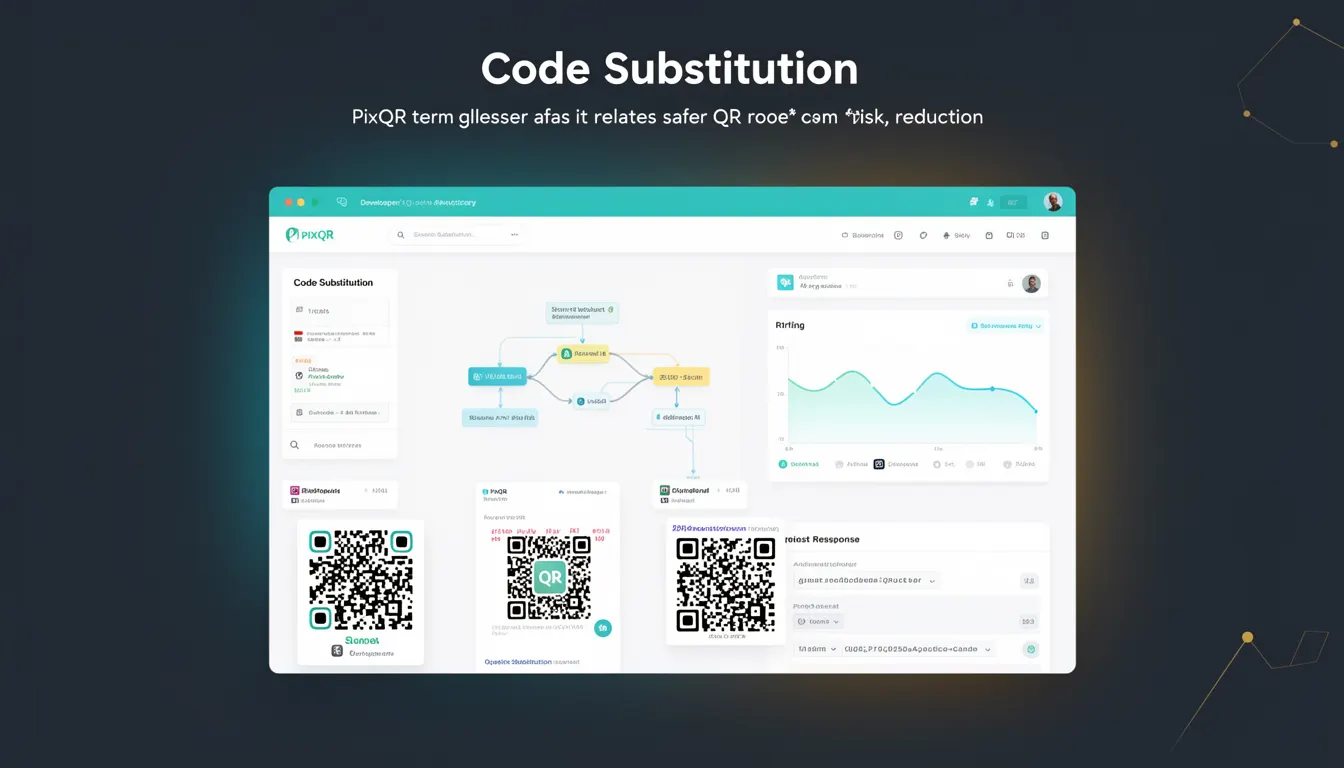
Code Substitution in PixQR operates through a multi-stage process that begins with QR code content parsing and continues through validation, transformation, and final redirection. The system evaluates incoming QR payloads against a set of configurable rules, applies transformations when necessary, and logs all actions for auditability.
- QR content is parsed upon creation or scan initiation, extracting the target URL or payload.
- Substitution rules are applied based on domain, content type, or context parameters.
- Validated replacements are generated, ensuring that new destinations are safe and compliant.
- Original content is replaced with the transformed payload, maintaining the integrity of the QR code structure.
- All substitution actions are logged with timestamps, user context, and rule identifiers for security analysis.
Key system components include:
- Rule engine that evaluates conditions for substitution
- Validation layer that checks substituted URLs against allowlists or security policies
- Context-aware substitution logic that considers user data, device type, or geo-location
- Logging and audit system that records all substitution events
- API integration points that allow external systems to influence substitution decisions
Quick Reference
| Component | Purpose | Implementation Notes |
|---|---|---|
| Substitution Rule | Defines when and how content is replaced | Must include match criteria and replacement logic |
| Validation Engine | Ensures safety of substituted URLs | Requires HTTPS enforcement and domain allowlists |
| Context Processor | Provides data for substitution decisions | Supports geo, device, and session parameters |
| Event Logger | Tracks substitution activities | Must include timestamps and user identifiers |
| API Interface | Enables external system integration | Supports real-time substitution overrides |
Basic Example
PixQR Example QR
This QR links directly to this glossary page, so printed notes, onboarding docs, and support material can bring scanners back to the current reference.
/glossary/qr-code-security/qr-code-security-code-substitution

This basic example demonstrates how a simple substitution rule might be applied to a QR code URL:
const originalUrl = 'http://example.com/redirect';
const substitutionRules = [
  {
    match: 'example.com',
    replace: 'https://secure.trusted-brand.com/redirect'
  }
];

function applySubstitution(url, rules) {
  for (const rule of rules) {
    if (url.includes(rule.match)) {
      return url.replace(rule.match, rule.replace);
    }
  }
  return url;
}

const result = applySubstitution(originalUrl, substitutionRules);
console.log(result); // https://secure.trusted-brand.com/redirect
The example shows a minimal implementation of substitution logic that replaces a domain with a secure alternative. In practice, this would be extended with URL validation, logging, and more sophisticated matching criteria.
Production Example
This production-ready example includes validation, logging, and context-aware substitution:
class QRCodeSubstitutionEngine {
  constructor() {
    this.rules = [];
    this.logger = new SubstitutionLogger();
  }

  addRule(match, replace, context = {}) {
    this.rules.push({ match, replace, context });
  }

  process(url, context = {}) {
    const validatedUrl = this.validateUrl(url);
    if (!validatedUrl) {
      this.logger.log('Invalid URL', { original: url, context });
      return null;
    }

    let result = url;
    for (const rule of this.rules) {
      if (this.ruleMatches(rule, url, context)) {
        result = url.replace(rule.match, rule.replace);
        this.logger.log('Substitution applied', {
          original: url,
          substituted: result,
          ruleId: rule.id,
          context
        });
        break;
      }
    }
    return result;
  }

  validateUrl(url) {
    try {
      const parsed = new URL(url);
      return parsed.protocol === 'https:';
    } catch (e) {
      return false;
    }
  }

  ruleMatches(rule, url, context) {
    if (rule.context && rule.context.geo && context.geo !== rule.context.geo) {
      return false;
    }
    return url.includes(rule.match);
  }
}
This example demonstrates a robust substitution engine that includes URL validation, context checking, and comprehensive logging. It is suitable for production use in enterprise environments where security and auditability are paramount.
Common Mistakes
- Not validating substituted URLs — Substituting URLs without HTTPS enforcement or domain checks can lead to security vulnerabilities and user exposure to malicious sites.
- Hardcoding substitution rules — Static rules are difficult to maintain and update, especially in rapidly evolving threat landscapes.
- Ignoring context-aware logic — Failing to consider user location, device type, or session data can result in inappropriate or ineffective substitutions.
- Overlooking performance impact — Complex substitution logic can introduce latency, particularly in high-volume QR code systems.
- Missing audit trails — Without logging substitution events, it becomes impossible to track or investigate suspicious activity or compliance violations.
Security And Production Notes
- Always enforce HTTPS for substituted URLs to prevent man-in-the-middle attacks and ensure encrypted communication.
- Implement domain allowlists and blacklists to restrict where QR codes can redirect, reducing exposure to malicious domains.
- Use context-aware substitution to personalize redirects while respecting user privacy and avoiding data leakage.
- Regularly audit substitution rules and logs to identify potential threats or misconfigurations in the system.
- Design substitution logic to be resilient to denial-of-service attacks or performance degradation under load.
Related Concepts
Code Substitution in PixQR is closely connected to several core concepts in QR code security and management:
- Dynamic QR Code Redirects — Substitution is often used in conjunction with dynamic redirects to modify QR content at runtime.
- URL Validation — Ensures that substituted URLs are safe and conform to security policies before redirection.
- Scan Tracking — Substitution events can be logged and analyzed to improve tracking and detect anomalies.
- Content Filtering — Rules that prevent certain content from being substituted or executed, enhancing security.
- Brand Safety — Ensures QR code destinations align with brand policies and avoid reputational risk.