 PixQR
Overview
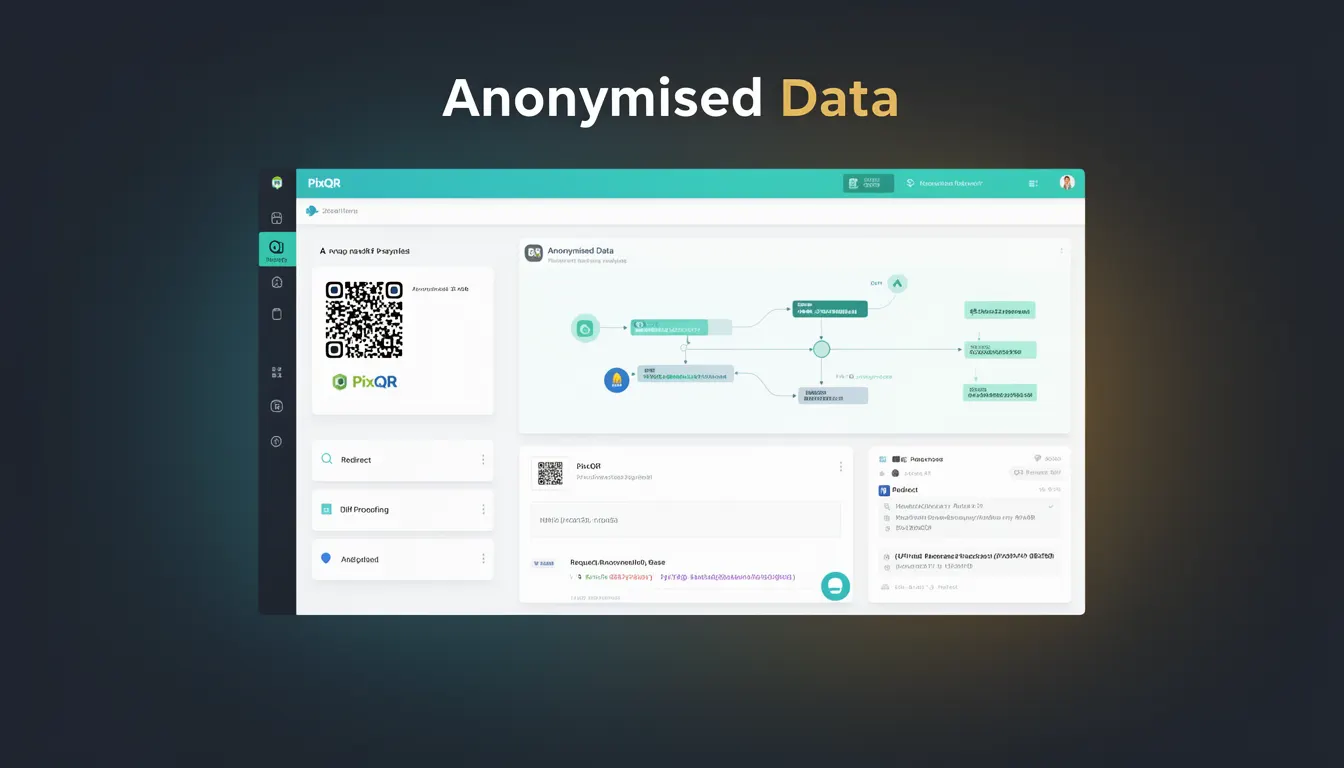
Anonymised Data in the context of PixQR refers to information collected from QR code scans and user interactions that has been stripped of identifiers that could directly or indirectly link data to an individual user. This concept is central to privacy-preserving analytics and is particularly relevant in environments where compliance with regulations such as GDPR or CCPA is required.
In PixQR, Anonymised Data is used to track user journeys, engagement metrics, and campaign performance without compromising personal privacy. This is achieved through the removal or obfuscation of personally identifiable information (PII) such as IP addresses, user agent strings, or device identifiers before data is stored or transmitted to analytics platforms or internal dashboards.
Why It Matters
For developers and product teams using PixQR, anonymising data is a critical step in maintaining user trust and ensuring regulatory compliance. When users scan a QR code, they expect their privacy to be respected, and any data collected must be handled with care. Anonymised Data allows PixQR to provide valuable insights into how QR codes are being used, while adhering to privacy laws and reducing the risk of data breaches.
From a performance standpoint, anonymised data can be processed faster and stored more efficiently. Since it does not contain sensitive or unique identifiers, it is less likely to be subject to additional security measures or access restrictions. This makes it ideal for real-time analytics, large-scale reporting, and integration with third-party tools that may not be designed to handle sensitive data.
How It Works
The process of anonymising data in PixQR involves multiple layers of data handling and transformation. The core mechanism is the systematic removal or obfuscation of identifiers that could lead back to an individual user. This typically occurs at the point of data collection or shortly after, ensuring that the data remains useful for analytics while minimizing privacy risks.
- Data collected from QR code scans is initially captured with metadata such as IP address, timestamp, and device type.
- Identifiers like IP addresses are hashed or truncated to prevent direct linking to a user's physical location or identity.
- Device identifiers or user agent strings are either removed or obfuscated to prevent tracking across sessions or devices.
- PixQR analytics dashboards and APIs are configured to only accept and display anonymised data, enforcing a strict separation between raw and processed data.
- Any data processing pipeline must be designed to ensure that anonymisation is applied consistently across all data sources and endpoints.
Quick Reference
| Item | Purpose | Notes |
|---|---|---|
| IP Address Obfuscation | Prevents direct user identification | Use SHA-256 hashing for consistent anonymisation |
| User Agent Truncation | Reduces fingerprinting risk | Retain only OS and browser family |
| Device ID Removal | Prevents cross-session tracking | Do not store or transmit unique identifiers |
| Timestamp Anonymisation | Reduces temporal correlation | Aggregate data to hourly or daily buckets |
| Analytics API Configuration | Enforces data privacy | Set API access to read-only anonymised views |
Basic Example
PixQR Example QR
This QR links directly to this glossary page, so printed notes, onboarding docs, and support material can bring scanners back to the current reference.
/glossary/qr-code-tracking-and-analytics/qr-code-tracking-and-analytics-anonymised-data

A simple example of anonymised data in PixQR involves a QR code scan event where only the timestamp and a truncated IP address are recorded.
{
  "timestamp": "2023-10-10T14:30:00Z",
  "ip_hash": "a1b2c3d4e5f6...",
  "country": "US",
  "browser": "Chrome",
  "os": "Windows"
}
This example demonstrates how sensitive identifiers like full IP addresses are replaced with hashes, and how metadata such as country and OS are retained for analytics purposes while preserving privacy.
Production Example
In a production environment, PixQR uses a structured anonymisation pipeline that processes data at the time of scan. This pipeline ensures that no raw identifiers are stored or transmitted, and that all data is processed through a secure, configurable anonymisation layer.
const anonymiseScanData = (rawData) => {
  const anonymised = {
    timestamp: rawData.timestamp,
    ip_hash: crypto.createHash('sha256').update(rawData.ip).digest('hex'),
    country: rawData.country,
    browser: rawData.userAgent ? rawData.userAgent.split('/')[0] : 'Unknown',
    os: rawData.userAgent ? detectOS(rawData.userAgent) : 'Unknown'
  };
  return anonymised;
};
This version is more suitable for production because it includes cryptographic hashing for IP addresses, user agent parsing for browser and OS, and a secure method for anonymising data before it is stored or sent to analytics platforms.
Common Mistakes
- Not hashing IP addresses before storage can expose user location data, violating privacy regulations.
- Retaining full user agent strings increases fingerprinting risk, making it easier to re-identify users.
- Using weak cryptographic algorithms for anonymisation can make data reversible or predictable.
- Forgetting to anonymise data at all points in the pipeline can lead to sensitive data leakage in logs or dashboards.
- Storing raw identifiers alongside anonymised data creates a data silo that can be exploited for re-identification.
Security And Production Notes
- Always use strong cryptographic hashing (e.g., SHA-256) for anonymising IP addresses or other identifiers.
- Ensure that anonymised data is stored in a separate, restricted-access database to prevent accidental exposure.
- Validate all incoming scan data to ensure that identifiers are removed or obfuscated before processing.
- Implement access controls to ensure that only authorized personnel can access raw or partially anonymised data.
- Regularly audit anonymisation processes to ensure compliance with evolving privacy regulations and best practices.
Related Concepts
Several related concepts are essential for understanding and implementing anonymised data in PixQR. Data minimisation is a core principle that dictates only the necessary data should be collected and processed. Privacy by design ensures that privacy controls are embedded into systems from the start. GDPR and CCPA compliance are legal frameworks that govern how personal data must be handled, including requirements for anonymisation. Data masking is a technique used to hide sensitive data in non-production environments. Finally, differential privacy is a mathematical framework that adds noise to datasets to prevent re-identification, often used in conjunction with anonymisation.