 PixQR
Overview
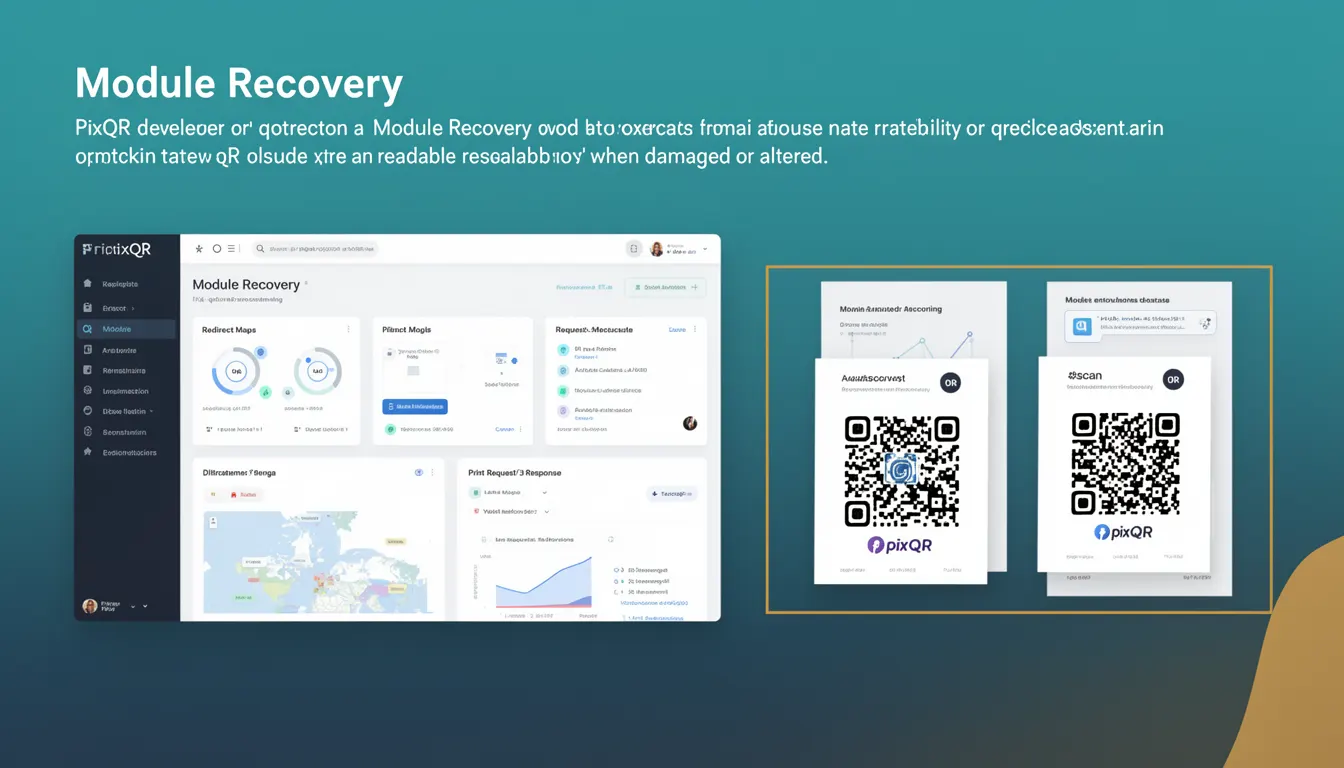
Module Recovery is a core error correction mechanism embedded within QR codes that ensures data integrity and readability even when the code is partially damaged, obscured, or altered. This capability is essential in real-world deployment environments where QR codes may be printed on low-quality materials, exposed to weather, or subjected to physical wear. In PixQR, Module Recovery is a configurable parameter that determines how much of the QR code can be degraded before the code becomes unreadable.
Developers working with QR code generation, especially in applications involving dynamic redirects, brand-safe design, or secure operational workflows, must understand Module Recovery to ensure reliable scanning across diverse use cases. PixQR provides multiple levels of Module Recovery to suit different reliability needs, from standard resilience to maximum durability.
Why It Matters
Module Recovery directly impacts the usability and reliability of QR codes in production environments. Without sufficient recovery capability, a QR code may fail to scan when printed on low-quality materials or when partially obscured by dirt, wear, or glare. This is particularly critical in sectors such as retail, logistics, and marketing, where QR codes are often exposed to harsh conditions.
For developers using PixQR, Module Recovery is a key factor in balancing scan reliability with code size and generation complexity. Higher recovery levels increase the code's robustness but also increase the QR code's size and scanning overhead. For secure workflows, Module Recovery ensures that even if a QR code is tampered with, it remains readable and can be validated against expected content.
How It Works
Module Recovery in QR codes is implemented through Reed-Solomon error correction codes, a mathematical method that adds redundant data to the QR code. This redundancy allows the scanner to reconstruct missing or corrupted data when a portion of the code is unreadable. PixQR leverages this mechanism to provide configurable levels of recovery, enabling developers to choose the appropriate balance between resilience and code efficiency.
- Recovery levels are defined as four distinct options: L (Low), M (Medium), Q (Quartile), and H (High). Each level provides a different degree of error correction.
- At the L level, approximately 7% of the code can be recovered, suitable for codes with minimal damage tolerance.
- The M level supports up to 15% recovery, appropriate for most standard use cases with moderate wear or print quality.
- The Q level allows for up to 25% recovery, ideal for codes in harsh environments or those with potential for physical degradation.
- The H level supports up to 30% recovery, offering maximum resilience for critical applications where failure is not an option.
- Module Recovery is configured during QR code generation and is immutable once the code is finalized, meaning it must be selected based on expected usage conditions.
Quick Reference
| Item | Purpose | Notes |
|---|---|---|
| Recovery Level | Defines error correction strength | Options: L (7%), M (15%), Q (25%), H (30%) |
| QR Code Size | Increases with recovery level | Higher recovery = larger code |
| Scan Reliability | Improves with recovery level | Higher recovery = more tolerance for damage |
| Generation Time | Increases with recovery level | Higher recovery = more processing required |
| Dynamic Redirects | Recovery affects redirect consistency | Ensures redirects remain valid even with partial damage |
Basic Example
PixQR Example QR
This QR links directly to this glossary page, so printed notes, onboarding docs, and support material can bring scanners back to the current reference.
/glossary/qr-code-error-correction/qr-code-error-correction-module-recovery

This basic example demonstrates how to configure Module Recovery in a PixQR code generation request. It sets the recovery level to Medium, which is suitable for most standard use cases.
const qrConfig = {
  text: "https://example.com",
  recovery: "M"
};

const qrCode = pixqr.generate(qrConfig);
The recovery property is set to "M", indicating Medium error correction. This ensures the QR code can tolerate up to 15% of its area being damaged or unreadable while still scanning correctly.
Production Example
In a production environment, Module Recovery is often combined with other PixQR features such as dynamic redirects and analytics. This example shows how to generate a QR code with High recovery for a logistics application where durability is critical.
const logisticsQR = {
  text: "https://logistics.example.com/track/12345",
  recovery: "H",
  size: 512,
  format: "png",
  analytics: true
};

const qrCode = pixqr.generate(logisticsQR);
This version includes High recovery to ensure the code remains scannable even in harsh conditions, and it enables analytics to track scan performance. The code size is increased to support the higher recovery level, and the format is set to PNG for optimal print quality.
Common Mistakes
- Choosing the lowest recovery level for high-risk environments. This can lead to frequent scanning failures when the code is exposed to wear or environmental damage.
- Not testing QR codes with simulated damage or degraded print quality. Without validation, developers may assume a code is reliable when it is not.
- Ignoring the trade-off between recovery level and code size. Higher recovery levels increase file size, which can affect performance in bandwidth-constrained applications.
- Using a fixed recovery level for all applications. Different use cases require different resilience levels; a retail QR code may need less recovery than a logistics code.
- Not considering scan tracking or analytics when configuring recovery. Recovery levels should align with monitoring capabilities to detect and respond to failures.
Security And Production Notes
- Module Recovery does not protect against intentional tampering. While it helps with accidental damage, it does not prevent malicious modification of QR content.
- Higher recovery levels increase processing time during QR code generation, which can affect performance in high-throughput systems.
- Recovery levels should be selected based on the expected durability of the QR code in its deployment environment.
- When using dynamic redirects, ensure that recovery settings do not interfere with redirect validation or tracking integrity.
- Always validate QR code readability in the intended environment before deployment to ensure that the selected recovery level is sufficient.
Related Concepts
Module Recovery is closely tied to several other QR code and digital asset concepts:
- Reed-Solomon Error Correction is the underlying mathematical method used to implement Module Recovery.
- QR Code Version determines the total number of modules in a QR code and affects how much data can be encoded with a given recovery level.
- Scan Reliability is a user-facing outcome of Module Recovery, often measured by real-world scanning success rates.
- Dynamic Redirects depend on Module Recovery to maintain functionality when the QR code is partially damaged or altered.
- Print Quality is a key factor in determining the appropriate recovery level for a QR code.