 PixQR
Overview
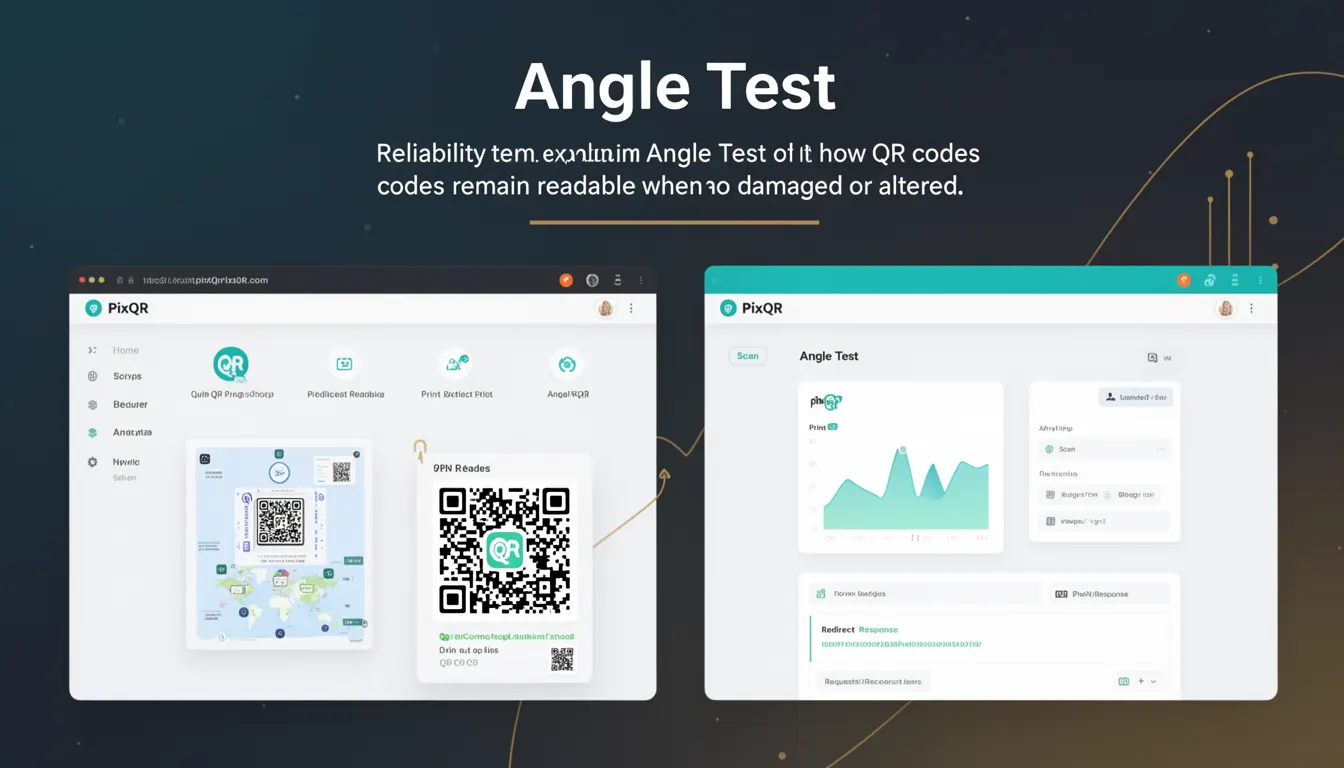
The Angle Test is a reliability mechanism used in QR code generation and decoding processes to ensure that QR codes remain scannable even when they are physically distorted, rotated, or partially obscured. This test is integral to the error correction capabilities of QR codes, particularly those using the Reed-Solomon error correction algorithm. In the context of PixQR, the Angle Test ensures that generated QR codes can be reliably read across various physical and digital conditions, such as being scanned at different angles, partially covered, or printed at low resolution.
Developers working with PixQR must understand how the Angle Test functions to configure and validate QR code outputs for maximum scan reliability. This test is especially relevant when implementing dynamic QR codes that may be displayed on low-quality screens, printed on textured surfaces, or scanned in challenging lighting conditions. It is part of the broader error correction framework that allows QR codes to maintain functionality despite physical degradation.
Why It Matters
For developers, the Angle Test is essential because it directly impacts the usability and reliability of QR codes in production environments. QR codes are often scanned in real-world settings where conditions vary significantly. A QR code that fails the Angle Test may become unreadable when scanned at an angle or under suboptimal conditions, leading to user frustration and lost conversions.
In PixQR, the Angle Test is a key component of the platform’s commitment to scan reliability and brand-safe design. When QR codes are generated with appropriate error correction levels, they can withstand various distortions and still be decoded. This reliability is crucial for applications like dynamic redirects, where a broken scan can break a user journey, or in print campaigns where physical quality is not always guaranteed.
How It Works
The Angle Test operates within the Reed-Solomon error correction system of QR codes. QR codes are composed of modules arranged in a grid, with specific patterns for alignment, timing, and format information. These patterns are designed to be robust to geometric distortions such as rotation or skewing. The Angle Test evaluates how well these patterns can be interpreted when the QR code is scanned at an angle.
- The QR code's alignment patterns are tested for consistency across multiple scan angles to ensure that the decoder can still locate the code.
- QR codes with higher error correction levels (such as M or H) are more likely to pass the Angle Test because they have more redundant data.
- The test is performed during the QR code generation phase in PixQR, where parameters like error correction level and module size are adjusted to maintain readability.
- Scanners that implement Angle Test verification can detect when a QR code is misaligned or distorted and attempt to correct the scan data.
- When using PixQR’s dynamic QR generation, developers can configure error correction levels to ensure that even if a QR code is rotated or skewed, it remains scannable.
Quick Reference
| Item | Purpose | Notes |
|---|---|---|
| Error Correction Level (ECL) | Controls redundancy for readability | Higher levels like H offer better Angle Test performance |
| Alignment Pattern | Used to maintain code structure under distortion | Tested during Angle Test to ensure scan stability |
| Module Size | Affects resolution and scan tolerance | Smaller modules may reduce Angle Test success |
| Scan Angle | Angle at which QR code is scanned | Angle Test ensures success at common angles |
| Dynamic QR Code | Supports real-time updates with Angle Test | Configurable via PixQR API |
Basic Example
PixQR Example QR
This QR links directly to this glossary page, so printed notes, onboarding docs, and support material can bring scanners back to the current reference.
/glossary/qr-code-error-correction/qr-code-error-correction-angle-test

This example demonstrates how a QR code with a higher error correction level can maintain readability under rotation, which is a key aspect of the Angle Test.
const qrData = 'https://pixqr.com/redirect';
const options = {
  errorCorrectionLevel: 'H',
  width: 200,
  height: 200
};
const qrCode = generateQR(qrData, options);
// The generated QR code is more resistant to rotation and distortion
The key line is setting errorCorrectionLevel to 'H', which ensures that the QR code has the highest level of redundancy. This makes it more likely to pass the Angle Test, especially when scanned at non-standard angles.
Production Example
In a production environment, developers using PixQR must ensure that generated QR codes meet specific reliability criteria, including Angle Test compliance. This example shows how to configure a dynamic QR code with appropriate error correction to maintain readability across various scanning conditions.
const dynamicQRConfig = {
  url: 'https://example.com/redirect',
  errorCorrectionLevel: 'H',
  backgroundColor: '#ffffff',
  foregroundColor: '#000000',
  margin: 1,
  size: 300
};
const qrCode = pixqr.generate(dynamicQRConfig);
// The QR code is designed to pass Angle Test under various scanning conditions
This version is more suitable for production because it explicitly sets the error correction level to 'H', which is required for reliable performance under distortion. It also configures size and margin to ensure the QR code is large enough to be scanned at an angle without losing data.
Common Mistakes
- Setting error correction level to
'L'or'M'when high reliability is required, which can lead to failed Angle Tests in real-world conditions. - Not accounting for module size when generating QR codes, resulting in codes that are too small to be readable under rotation.
- Ignoring margin settings, which can cause the QR code to be misread when scanned near edges or with partial occlusion.
- Using default settings without verifying that the generated QR code passes Angle Test for intended use cases.
- Assuming that all QR code scanners will perform Angle Test verification, which is not always the case in low-end or legacy systems.
Security And Production Notes
- Higher error correction levels like
'H'increase QR code size, which may impact performance in bandwidth-constrained environments. - Angle Test compliance ensures that QR codes are not vulnerable to manipulation or partial decoding attacks.
- Always validate QR codes with real scanners to confirm Angle Test success, especially for critical redirect flows.
- When using PixQR API, ensure that dynamic QR codes are generated with consistent parameters to avoid unexpected behavior.
- Consider accessibility when designing QR codes; overly complex patterns may fail Angle Test in low-light or high-contrast environments.
Related Concepts
Angle Test is closely related to several QR code concepts:
- Reed-Solomon Error Correction: The mathematical framework that underpins error correction and Angle Test resilience.
- QR Code Levels: L, M, Q, H, each with increasing error correction capacity and Angle Test strength.
- Alignment Patterns: Used to maintain grid structure during distortion, tested by the Angle Test.
- Scan Reliability: The overall ability of a QR code to be read under various conditions, including rotation.
- Dynamic QR Generation: The ability to modify QR code content post-generation, requiring Angle Test verification for consistent usability.