 PixQR
Overview
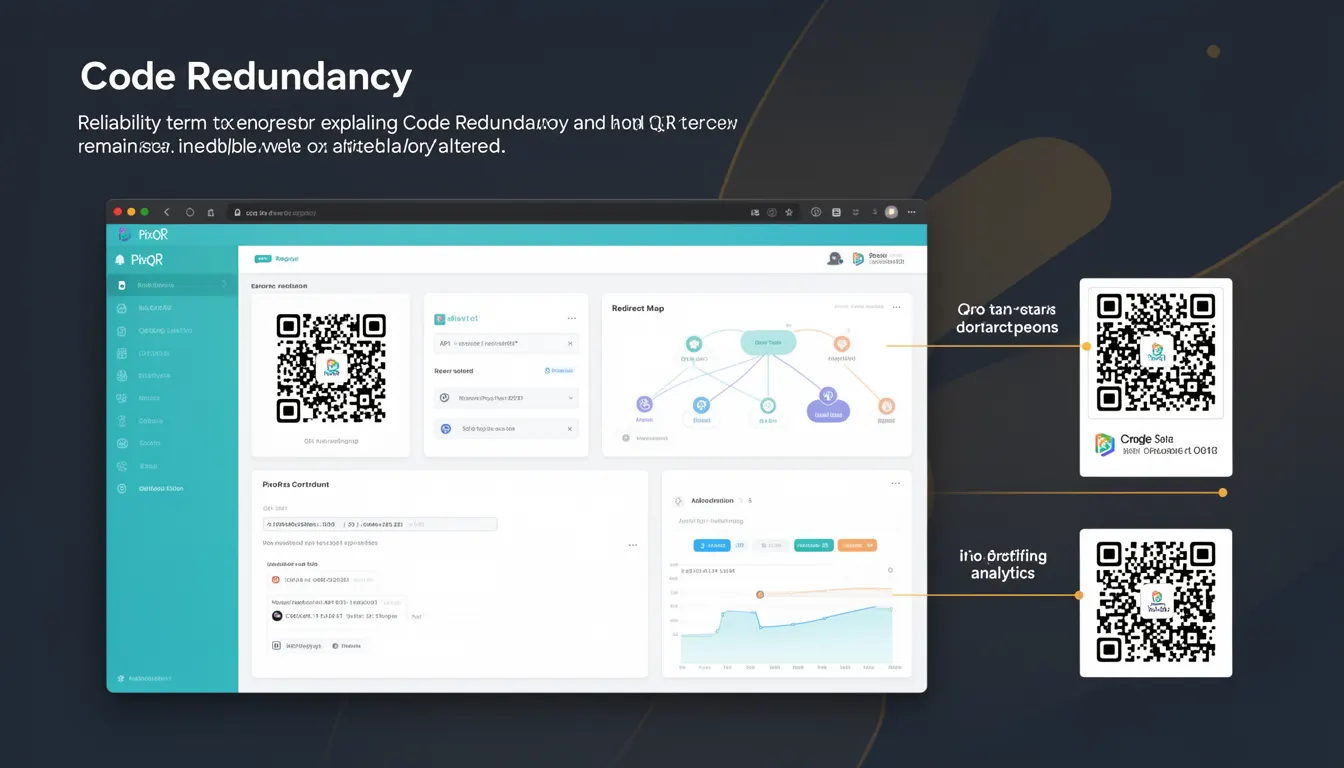
Code Redundancy in the context of QR codes refers to the inclusion of extra data within a QR code that allows the code to remain scannable and readable even when partially damaged, obscured, or altered. This mechanism is integral to the QR code's error correction capabilities, enabling systems to recover information from codes that may have been printed on low-quality materials, exposed to environmental factors, or intentionally modified.
For developers working with PixQR, understanding Code Redundancy is essential when generating QR codes for high-reliability applications. PixQR provides options to configure error correction levels, which directly influence how much redundancy is embedded into each QR code. This ensures that codes remain functional even under suboptimal conditions, such as when printed on fabric, exposed to water, or scanned through a dirty camera lens.
Why It Matters
Code Redundancy directly impacts the usability and robustness of QR codes in production environments. In real-world applications, QR codes are scanned in diverse conditions—some may be partially obscured, degraded, or printed on materials that affect readability. Without sufficient redundancy, a code may fail to scan, leading to user frustration and potential loss of functionality.
For developers managing systems that rely on QR codes for dynamic redirects, PixQR's error correction settings allow them to balance between code size and reliability. A higher error correction level increases redundancy, which enhances reliability but also increases the QR code's file size. This trade-off is particularly important when designing codes for physical media like signage or printed materials, where environmental factors must be accounted for.
How It Works
QR codes utilize Reed-Solomon error correction to achieve Code Redundancy. The error correction level is defined by four levels: L (Low), M (Medium), Q (Quartile), and H (High). Each level specifies the percentage of data that can be recovered from the code. Higher levels allow for greater tolerance of damage or corruption.
- Level L (7%) allows for up to 7% of the code to be corrupted and still be readable.
- Level M (15%) allows for up to 15% of the code to be corrupted and still be readable.
- Level Q (25%) allows for up to 25% of the code to be corrupted and still be readable.
- Level H (30%) allows for up to 30% of the code to be corrupted and still be readable.
- Each error correction level increases the QR code's redundancy and data size proportionally.
When a QR code is generated, the system calculates how much redundancy is needed based on the selected error correction level. This redundancy is encoded into the QR code's structure using mathematical algorithms that ensure data integrity even when parts of the code are unreadable.
Quick Reference
| Item | Purpose | Notes |
|---|---|---|
| Error Correction Level | Defines how much redundancy is added to a QR code | Higher levels increase reliability but reduce code size efficiency |
| Reed-Solomon Encoding | Mathematical method for adding redundancy | Used to recover lost data from corrupted QR codes |
| QR Code Version | Indicates the size of the QR code matrix | Higher versions support more data and redundancy |
| Data Capacity | Amount of data that can be stored in a QR code | Increases with version and error correction level |
| Scanning Tolerance | Percentage of code that can be damaged and still be readable | Depends on selected error correction level |
Basic Example
PixQR Example QR
This QR links directly to this glossary page, so printed notes, onboarding docs, and support material can bring scanners back to the current reference.
/glossary/qr-code-error-correction/qr-code-error-correction-code-redundancy

The following example demonstrates how to configure error correction in a PixQR code generation request using a simple JSON structure. It sets the error correction level to Medium (M).
{
  "data": "https://example.com",
  "error_correction": "M"
}
The error_correction field specifies the level of redundancy to include in the generated QR code. In this case, the value "M" indicates that 15% of the code can be corrupted and still be readable. This configuration is suitable for most digital or semi-permanent print applications.
Production Example
In a production environment, developers might configure a QR code with a higher error correction level to ensure reliability in challenging environments. The following example shows how to set up a QR code with High (H) error correction for a physical product label that may be exposed to wear or environmental damage.
{
  "data": "https://shop.example.com/product/12345",
  "error_correction": "H",
  "version": 10,
  "output_format": "png"
}
This configuration ensures that the QR code remains scannable even if it is partially damaged, making it suitable for applications such as inventory tracking, product identification, or labels on outdoor signage. The version number is set to 10 to allow for sufficient data and redundancy capacity.
Common Mistakes
- Choosing a low error correction level for codes that will be printed on low-quality materials or exposed to wear.
- Ignoring the trade-off between redundancy and QR code size when optimizing for performance or storage.
- Assuming that all QR codes are equally reliable, without considering environmental factors or intended use.
- Not validating the generated QR code for scannability before deployment.
- Using default settings without considering the specific reliability requirements of the application.
Security And Production Notes
- Higher error correction levels increase the QR code's data size, which may impact performance in bandwidth-constrained environments.
- Ensure that QR codes with high redundancy are not used in contexts where size or data efficiency is critical.
- Validate generated codes with scanning tools to confirm that the intended error correction level works as expected.
- Consider accessibility implications when using error correction levels that may increase code complexity or scanning time.
- For dynamic redirects, ensure that the error correction level does not introduce unintended data exposure or tracking vulnerabilities.
Related Concepts
Code Redundancy is closely related to several core QR code technologies and practices:
- Reed-Solomon Error Correction — The mathematical method used to implement redundancy in QR codes.
- QR Code Version — A measure of the matrix size that determines how much data and redundancy can be included.
- Scanning Reliability — The ability of a QR code to be successfully scanned under various conditions.
- Dynamic Redirects — Systems that use QR codes to redirect users to dynamic content, where reliability is key.
- Print Quality — Environmental factors that affect how well a QR code can be scanned, often requiring higher redundancy.