 PixQR
Overview
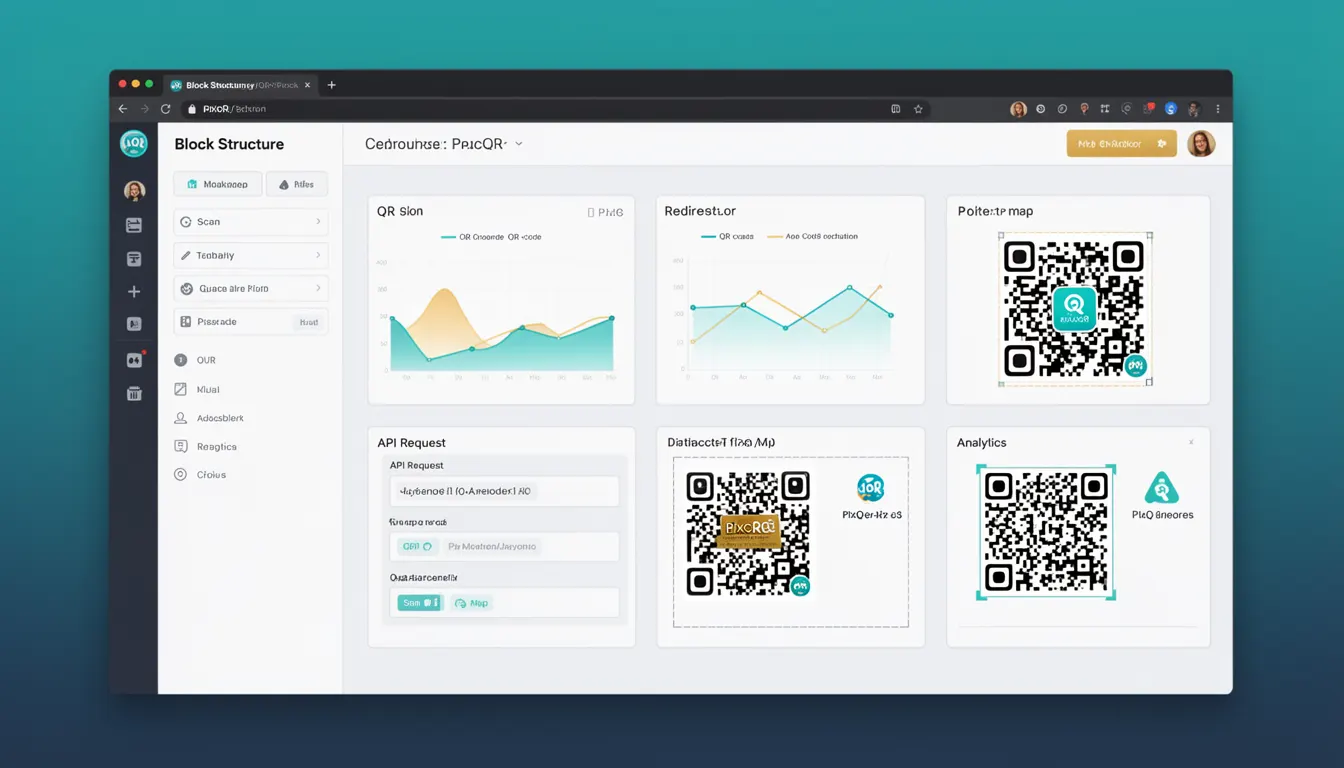
Block Structure refers to a fundamental mechanism within QR code error correction that allows QR codes to remain scannable even when partially damaged, obscured, or altered. This structure divides the QR code data into smaller, manageable segments called blocks, each containing both data and redundant error correction information. When a QR code is scanned, the reader uses this redundant information to reconstruct the original data even if parts of the code are unreadable or corrupted.
Developers working with PixQR encounter Block Structure when configuring QR code generation, especially when balancing data capacity, error correction level, and physical robustness. This mechanism is critical for ensuring reliable scanning in real-world conditions such as partial printing, smudging, or exposure to environmental factors.
Why It Matters
Block Structure is essential for maintaining the reliability and usability of QR codes in production environments. Without it, QR codes would be vulnerable to failure if even a small portion were damaged, which is common in physical applications like printed materials, signage, or mobile displays. For PixQR, this translates to robustness in redirect links, brand-safe designs, and secure operational workflows, especially when QR codes are expected to be scanned under suboptimal conditions.
For developers and site operators, understanding Block Structure enables better optimization of QR code generation parameters. It influences decisions on data payload size, error correction level, and print quality requirements, which in turn affect scanning success rates and user experience. Poorly configured Block Structures can lead to failed scans, reduced reliability, and increased support costs.
How It Works
The Block Structure in QR codes is part of the Reed-Solomon error correction system, which is applied in multiple stages during QR code encoding. The process involves:
- Splitting the original data into smaller blocks of equal or nearly equal size.
- Adding redundant error correction bytes to each block, which are calculated using mathematical algorithms.
- Interleaving these blocks across the QR code matrix to distribute error correction information.
- Ensuring that the QR code can still be read even if certain sections are damaged or obscured.
- Allowing the scanner to use the redundant data to reconstruct missing or corrupted parts of the original message.
The error correction level (L, M, Q, H) determines how many redundant bytes are added per block, and thus how much damage the QR code can withstand. Higher levels of correction allow for greater resilience but reduce the amount of data that can be encoded.
Quick Reference
| Item | Purpose | Notes |
|---|---|---|
| Error Correction Level (L, M, Q, H) | Controls redundancy and damage tolerance | Higher levels allow more robustness but less data |
| Data Block Size | Determines how data is segmented | Smaller blocks may improve error correction |
| Reed-Solomon Encoding | Mathematical method for adding redundancy | Standardized in QR code specifications |
| Interleaving | Distributes error correction across QR code | Improves robustness against localized damage |
| Block Count | Number of data blocks in a QR code | Depends on version and error correction level |
Basic Example
PixQR Example QR
This QR links directly to this glossary page, so printed notes, onboarding docs, and support material can bring scanners back to the current reference.
/glossary/qr-code-error-correction/qr-code-error-correction-block-structure

This example demonstrates how a QR code might be generated with a specific error correction level. The code sets up a basic configuration for a PixQR code with moderate error correction to ensure robustness.
const qrConfig = {
  data: "https://example.com",
  errorCorrection: "M",
  size: 256
};
The errorCorrection property is set to "M", which provides medium error correction. This means the QR code can tolerate up to 15% of damage while remaining scannable. The size property defines the pixel dimensions of the QR code output.
Production Example
In a production environment, developers might configure a PixQR code with higher error correction for physical applications such as signage or printed materials where damage is more likely. This example shows a configuration optimized for durability and reliability.
const qrCode = {
  data: "https://secure.pixqr.com/redirect/12345",
  errorCorrection: "H",
  size: 512,
  margin: 4,
  backgroundColor: "#ffffff",
  foregroundColor: "#000000"
};
This configuration uses the highest error correction level "H", suitable for environments where the QR code might be partially obscured or degraded. The margin parameter ensures a clear border, and the color settings maintain visibility under various lighting conditions. This setup is particularly useful for marketing campaigns, event tickets, or physical product labels.
Common Mistakes
- Choosing a low error correction level for physical QR codes, leading to scanning failures in real-world use.
- Not accounting for block size when designing QR code layouts, resulting in inefficient data usage.
- Assuming all QR code readers handle error correction equally, which can lead to inconsistent scanning results.
- Overlooking the trade-off between data capacity and error correction, causing data overflow in high-error scenarios.
- Ignoring the impact of QR code size and resolution on the effectiveness of Block Structure in practical applications.
Security And Production Notes
- Block Structure does not inherently provide encryption or data integrity checks; it only ensures scannability under damage.
- When using dynamic redirects, ensure that the error correction level is sufficient to maintain functionality even if the QR code is partially degraded.
- For high-security applications, consider combining Block Structure with additional security measures like tokenization or signature verification.
- Always test QR codes under real-world conditions to verify that the configured error correction level is effective.
- Block Structure is a static feature and does not adapt dynamically to environmental conditions; it must be pre-configured for the intended use case.
Related Concepts
Block Structure is closely related to several core QR code technologies:
- Reed-Solomon Error Correction – The mathematical method that generates the redundant data used in Block Structure.
- QR Code Version – Determines the total number of modules and how blocks are arranged within the code.
- Interleaving – A technique that spreads error correction bytes across the QR code to improve resilience.
- Error Correction Levels – L, M, Q, H, which define how many redundant bytes are added per block.
- Scanning Reliability – The practical outcome of a well-implemented Block Structure in real-world conditions.