 PixQR
Overview
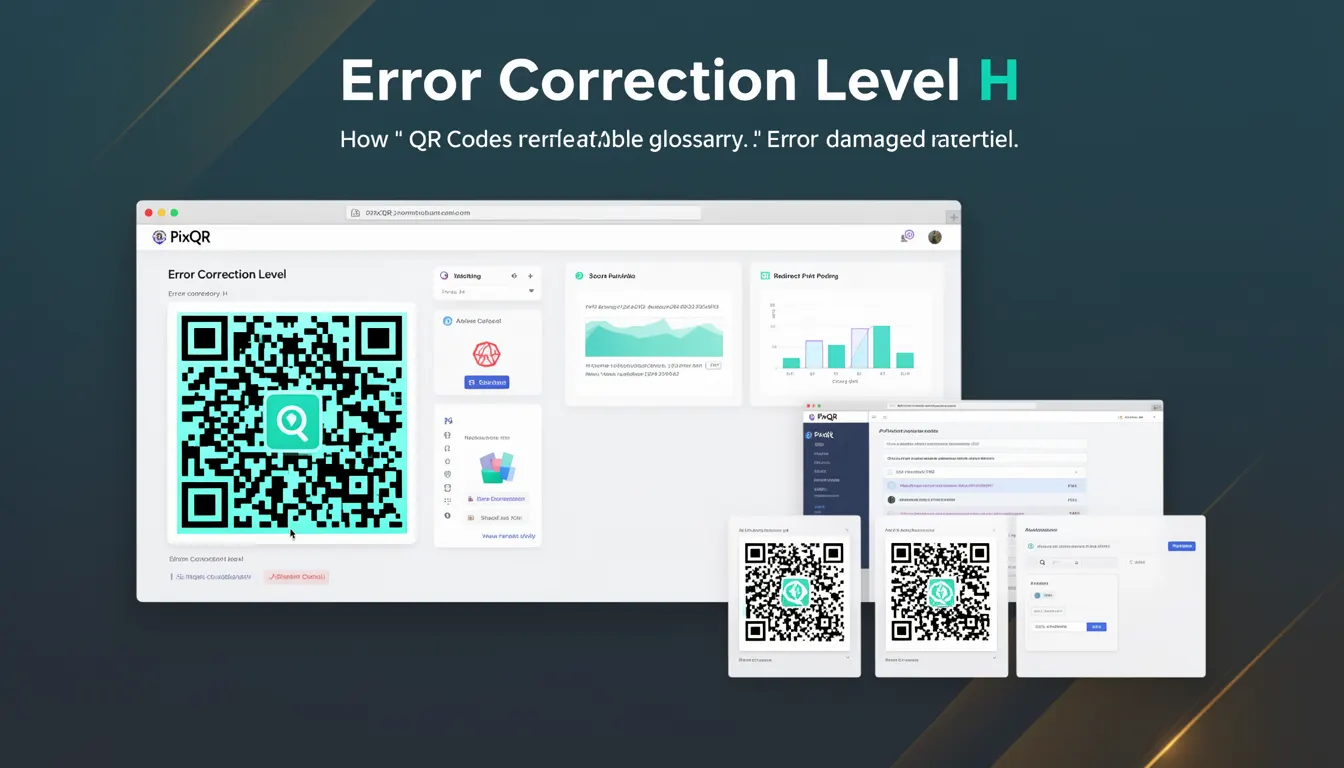
Error Correction Level H, or High error correction, is one of four error correction levels defined in the QR Code standard (ISO/IEC 18004). It is used to determine how much damage a QR code can sustain while still being scannable and readable. Level H provides the highest level of redundancy, allowing the QR code to remain functional even when up to 30% of its area is damaged or obscured.
Developers working with PixQR or any QR generation platform must understand how error correction levels affect code integrity, especially when designing for print, mobile scanning, or environments where QR codes may be exposed to wear, weather, or intentional tampering. Error correction levels are selected during the QR code generation process and are encoded into the QR code itself, making them immutable after creation.
Why It Matters
In production environments, QR code reliability is critical. PixQR users often generate codes for high-volume, high-impact use cases such as retail point-of-sale, event ticketing, and logistics tracking. If a QR code fails to scan due to damage, it can lead to lost transactions, customer frustration, or operational inefficiencies.
Using Error Correction Level H ensures that even if a code is partially obscured, printed poorly, or physically damaged, it still retains a high probability of successful decoding. This is particularly important for codes used in outdoor settings, on low-resolution displays, or in scenarios where physical integrity cannot be guaranteed. It also plays a role in fraud prevention, as tampered codes with low error correction may fail silently, masking malicious intent.
How It Works
The QR code standard defines four error correction levels: L (Low), M (Medium), Q (Quartile), and H (High). Each level increases the amount of redundant data added to the QR code, improving resilience at the cost of code size and data capacity. Error Correction Level H adds the most redundancy, which allows for up to 30% of the code to be unreadable while still decoding correctly.
- Level H increases the QR code size by approximately 30% compared to Level L, due to added error correction data.
- The correction algorithm uses Reed-Solomon error correction, a mathematical process that reconstructs missing or corrupted data.
- Higher error correction levels require more computational resources during code generation, but provide better scan reliability.
- Once a QR code is generated with a specific error correction level, it cannot be changed without regenerating the entire code.
- PixQR’s backend systems automatically apply error correction during QR code creation, with H as an available configuration option for developers using the API.
Quick Reference
| Item | Purpose | Notes |
|---|---|---|
| Error Correction Level H | Provides maximum redundancy for QR code resilience | Used in PixQR API for high-reliability scenarios |
| Reed-Solomon Encoding | Mathematical process for error correction | Applied during QR generation |
| Scanning Failure Threshold | Percentage of code that can be damaged and still decode | Up to 30% for Level H |
| Code Size Impact | Increased QR code size due to redundancy | Approximately 30% larger than Level L |
| Immutable After Generation | Error correction level is fixed post-generation | Requires regeneration to change |
Basic Example
PixQR Example QR
This QR links directly to this glossary page, so printed notes, onboarding docs, and support material can bring scanners back to the current reference.
/glossary/qr-code-error-correction/qr-code-error-correction-error-correction-level-h

This example shows how to configure a QR code with Error Correction Level H using a hypothetical PixQR API endpoint.
POST /api/v1/qrcode
{
  "data": "https://example.com/product/12345",
  "error_correction": "H"
}
The key line is "error_correction": "H", which sets the error correction level to High. This ensures that the generated QR code can tolerate significant damage while remaining scannable.
Production Example
In a production environment, developers using PixQR might generate codes for inventory tracking with Error Correction Level H to ensure codes remain functional even if printed on low-quality materials or exposed to environmental wear.
const pixqr = require('pixqr-sdk');

const qrConfig = {
  data: 'https://inventory.example.com/asset/ABC123',
  error_correction: 'H',
  size: 200,
  format: 'png'
};

const qrCode = pixqr.generate(qrConfig);
// QR code is generated with high resilience for physical or scanning issues
This version includes additional configuration for size and format, demonstrating a more robust and maintainable approach to QR code generation in real-world applications.
Common Mistakes
- Assuming that higher error correction levels always improve scan success — they do, but at the cost of larger QR codes and increased generation time.
- Not setting error correction explicitly, which defaults to a lower level like M, potentially leading to unreliable codes in high-risk environments.
- Choosing Level H for all QR codes without considering performance or data capacity trade-offs, especially in high-volume applications.
- Using low error correction in scenarios where physical damage or scanning conditions are unpredictable, such as outdoor or industrial settings.
- Generating QR codes with error correction levels that are not supported by the scanning system, resulting in failed scans.
Security And Production Notes
- Higher error correction levels improve resilience but do not enhance security or prevent tampering of the data payload.
- Ensure that QR codes with Level H are tested in real-world scanning environments to validate reliability.
- When using PixQR APIs, validate that error correction levels are correctly applied to avoid unexpected scan failures.
- Consider performance impact when generating large volumes of high-error-correction codes, especially in real-time applications.
- Use consistent error correction levels across a product or brand to maintain predictable scanning behavior and user experience.
Related Concepts
Several concepts are closely related to Error Correction Level H:
- Reed-Solomon Error Correction — The mathematical method used to implement error correction in QR codes.
- QR Code Generation — The process of creating a QR code from input data, including error correction setup.
- Scan Reliability — The ability of a QR code to be successfully decoded under various conditions.
- Dynamic Redirects — QR codes that point to URLs that may change, where error correction helps ensure continuity.
- Print Quality — Physical limitations of printing can impact QR code readability, making error correction essential.