 PixQR
Overview
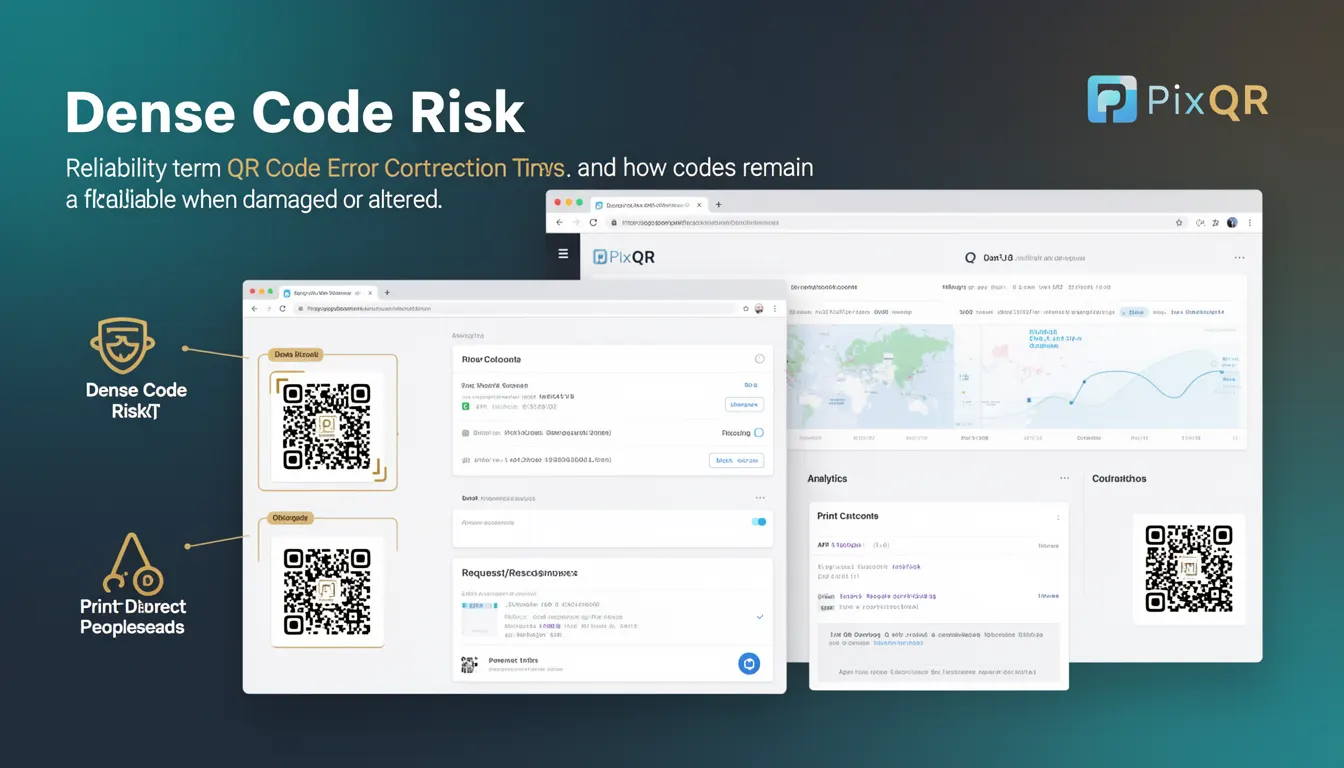
Dense Code Risk is a reliability metric that quantifies how much physical damage or alteration a QR code can sustain while still remaining scannable and readable. It is a core concept in QR code error correction, directly tied to the level of redundancy encoded within the code. In the context of PixQR, understanding Dense Code Risk is essential for ensuring that QR codes remain functional in real-world conditions such as wear, smudging, partial occlusion, or environmental interference.
Developers working with PixQR must consider Dense Code Risk when designing QR code layouts for print, digital distribution, or dynamic redirects. This term is especially relevant when generating codes for environments where physical degradation is likely, such as outdoor signage, product packaging, or mobile applications where scanning may be attempted under poor lighting or with a dirty lens.
Why It Matters
For developers and product teams, Dense Code Risk directly impacts the user experience and operational reliability of QR code systems. If a QR code has low Dense Code Risk, it may fail to scan under minor physical damage, leading to lost conversions, frustrated users, or failed redirect operations. PixQR’s platform allows developers to configure and test error correction levels to balance code density with resilience.
From a security perspective, Dense Code Risk can be a vulnerability if a code is intentionally degraded to obscure its content, but it also provides a safety net for legitimate physical wear. In production workflows, this term guides decisions on whether to use higher error correction levels, which increases the code size and scan time but improves reliability.
How It Works
Dense Code Risk is determined by the QR code’s error correction level, which is one of four defined levels: L (Low), M (Medium), Q (Quartile), and H (High). Each level adds a different amount of redundancy to the data, allowing the code to remain readable even when a percentage of its pixels are damaged or obscured.
- Level L provides 7% redundancy, suitable for codes with minimal physical risk.
- Level M provides 15% redundancy, a good balance for most applications.
- Level Q provides 25% redundancy, ideal for codes exposed to wear or environmental stress.
- Level H provides 30% redundancy, best for codes with high physical risk or critical data integrity needs.
- The error correction algorithm uses Reed-Solomon codes to reconstruct missing data.
In PixQR, developers can configure these levels during QR code generation. Higher error correction levels result in larger codes with more modules, increasing the time and memory required for rendering and scanning. The platform provides analytics to track scan success rates and help optimize for Dense Code Risk in real-world deployments.
Quick Reference
| Item | Purpose | Notes |
|---|---|---|
| Error Correction Level | Controls redundancy in QR code | Higher levels = more resilience |
| Reed-Solomon Encoding | Algorithm for error correction | Used to reconstruct missing data |
| Scan Success Rate | Measure of code reliability | Monitored via PixQR analytics |
| Code Size | Impact of error correction | Higher correction = larger QR code |
| Physical Degradation | Factors affecting Dense Code Risk | Smudging, occlusion, lighting |
Basic Example
PixQR Example QR
This QR links directly to this glossary page, so printed notes, onboarding docs, and support material can bring scanners back to the current reference.
/glossary/qr-code-error-correction/qr-code-error-correction-dense-code-risk

This example demonstrates how to configure a QR code with a high error correction level to minimize Dense Code Risk in a basic PixQR setup.
const qrCode = {
  data: "https://example.com",
  errorCorrection: "H",
  size: 256
};
The errorCorrection property is set to "H" to enable the highest level of redundancy. This configuration ensures that even if a significant portion of the QR code is damaged, it can still be scanned successfully.
Production Example
In a production environment, a developer might use PixQR’s API to generate a QR code with error correction optimized for physical wear in outdoor conditions.
const payload = {
  url: "https://pixqr.com/redirect/12345",
  options: {
    correction: "Q",
    margin: 1,
    color: "#000000",
    background: "#ffffff"
  }
};

const qrResponse = await fetch("/api/generate", {
  method: "POST",
  body: JSON.stringify(payload)
});
This version includes explicit configuration for error correction level "Q", which is suitable for outdoor or high-traffic use cases. It also includes margin and color settings for print clarity, and it uses a secure API endpoint for code generation.
Common Mistakes
- Using the lowest error correction level for codes in high-risk environments, leading to frequent scan failures.
- Ignoring scan analytics to validate Dense Code Risk in real-world usage.
- Overlooking the trade-off between code size and reliability when optimizing for performance.
- Not accounting for physical wear or environmental factors during code design.
- Assuming that all QR code readers handle error correction the same way, which can cause compatibility issues.
Security And Production Notes
- Higher error correction levels increase code size, which may affect load times or print quality.
- Ensure that QR codes are tested under realistic physical conditions to validate Dense Code Risk.
- Use PixQR’s analytics to monitor scan success rates and adjust correction levels as needed.
- Validate that error correction does not introduce unintended data reconstruction in dynamic links.
- When generating codes for sensitive applications, consider that high correction levels may obscure subtle physical anomalies that could be used for fraud detection.
Related Concepts
Dense Code Risk is closely related to several core QR code concepts:
- Reed-Solomon Error Correction – The mathematical method used to encode redundancy into QR codes.
- QR Code Version – The size category of a QR code, which affects how much data and error correction it can contain.
- Scan Reliability – The overall chance a QR code will be successfully scanned under given conditions.
- Dynamic Redirect – A QR code that points to a URL which can change without re-generating the code.
- Print Quality – The physical fidelity of the QR code, which directly affects how much damage it can withstand.